Wildfires aren’t just a California problem.
They’re burning on four continents at once, and the numbers this week are staggering. Here’s where things stand as of July 30, 2026.
The US: 92 large fires and counting.
Firefighters are currently working to suppress and contain 92 large fires across the country, with 9 new large incidents reported just since yesterday. That effort now involves 25,244 firefighters and support personnel, backed by 558 crews, 1,525 engines, and 156 helicopters—essentially a small city’s worth of personnel spread across active fire lines nationwide.
So far this year, 42,651 fires have burned more than 4.5 million acres across the United States—roughly the size of Connecticut and Rhode Island combined, and we’re not even through peak fire season yet. The Northwest is bearing the brunt of it right now, with 48 uncontained large fires and 19 Complex Incident Management Teams currently committed across Oregon and Washington.
Here’s the part that matters most for homeowners, though: most of this is preventable. Human activities are responsible for approximately 90% to 95% of all wildfires in California—meaning the vast majority of what we’re dealing with didn’t have to happen. If you’re heading outdoors this fire season, a few basics go a long way: check local fire restrictions before you go, fully extinguish campfires until they’re cool to the touch, avoid parking on dry grass (a hot undercarriage can ignite it), never discard a cigarette from a moving vehicle, and if you’re towing a trailer, make sure the safety chains are secured and not dragging—a dragging chain throws sparks that can ignite roadside vegetation without anyone noticing.
Europe: three countries, hundreds of thousands evacuated.
If the US numbers are bad, Europe’s are worse in a different way—this is an active, fast-moving emergency affecting hundreds of thousands of people right now.
In southwest France, strong winds are pushing flames toward Bordeaux, and officials are candid about the situation: one said they “are far from having the fire under control.” Firefighter Captain Nicolas Braz described the blaze as having created its own weather system—”its own winds, complete with whirlwinds”—calling it “erratic and unmanageable.” That’s a fire large and hot enough to generate its own microclimate, which makes it exponentially harder to predict or contain.
Around 250,000 people in the Gironde and Landes regions have been evacuated. France has mobilized its military, sending army reinforcements to help clear brush and cut fire breaks alongside civilian crews. President Macron has pledged the government will “rebuild” and stay involved “for as long as is needed.” Roughly 98,000 hectares have burned across France so far this year.
Spain, meanwhile, has declared a state of emergency. Nearly 60,000 people have been evacuated from the Madrid and Ávila regions, and more than 28,000 remain confined to their homes. At least eight municipalities near Toledo were also ordered to evacuate. Madrid’s regional president, Isabel Díaz Ayuso, called it the worst fire in the region’s history—a strong statement given Spain’s long history with wildfire. The numbers back her up: 130,000 hectares have burned in Spain this year already, well above the country’s 10-year average of 100,000 hectares. PM Pedro Sánchez summed it up simply, calling it “complex times ahead.” There’s at least one bright spot: a shift in weather conditions has recently started helping firefighters gain ground outside Madrid.
Combined, more than 300,000 people across France and Spain have been forced to flee their homes. And it’s not just those two countries—in Sicily, more than 350 fires broke out, including 10 major blazes, prompting evacuations across the island. In Scotland, emergency services declared a major incident over a wildfire in Cairngorms National Park that’s now been burning for 10 straight days—a reminder that wildfire risk is no longer confined to the traditionally fire-prone Mediterranean.
Canada: fires that simply can’t be fought.
Canada’s situation is fundamentally different, and it’s the most sobering part of this story. It’s not primarily a resource problem—it’s a geography problem.
Canadian fire seasons used to be short. They’re not anymore: warmer weather extends the season, and warmer conditions also generate more lightning. Lightning now causes half of all Canadian wildfires—but because lightning strikes disproportionately in remote boreal forest, those lightning-caused fires are responsible for 92% of all forest area burned in the country.
Most Canadian wildfires simply aren’t fightable in any conventional sense. Many areas burning right now—including fires currently active in northern Ontario—are unpopulated or home to small Indigenous communities, reachable only by plane, with no roads for ground crews. Water scoopers can slow a fire’s spread and buy time, but actually extinguishing one requires boots on the ground, and in these areas there’s often no way to get people there in time.
Timing compounds the geography problem. Fire management expert Michael Flannigan, of Thompson Rivers University in British Columbia, put it bluntly: most fires are only stoppable if crews respond within the first 30 minutes. After that window closes, he said, “even if we spend a lot more money, I don’t think we could stop these fires.” In remote areas, that window closes long before anyone even knows the fire has started.
There’s also a forest-management wrinkle: fire isn’t purely destructive for these ecosystems. Long-term, it clears flammable material and promotes regeneration—a lesson Canadian officials have learned managing national parks like Banff, where suppressing every fire tends to increase long-term risk. The bigger trend, though, is unmistakable: the area burned by Canadian wildfires has nearly quadrupled since the 1970s, which Flannigan attributes “largely, not solely, [to] human-caused climate change.”
Bottom line:
Three continents, three very different fire stories. The US problem is largely preventable—basic outdoor precautions genuinely move the needle. Europe’s crisis is about speed and scale overwhelming resources in real time. Canada’s isn’t preventable in the same way at all—it’s a geography and climate story where most fires simply can’t be reached. Different causes, same lesson: prevention and home hardening matter more every season, because once a fire gets going, there’s often no fighting it at all.
Home hardening isn’t just vents and roofs. Ember-resistant window upgrades—double-pane, tempered glass, mesh screening—help keep windows from shattering under radiant heat, which is another common way embers get inside the home. Fire-resistant insulation (mineral wool, fiberglass, glass wool with flame retardants) helps limit damage if embers do get past your first line of defense.
The vegetation around the home is the fuel that determines the fire’s path to the home. Landscaping the vegetation plays a big part in wildfire mitigation. Fire-resistant plants, ignition-resistant mulch, and hardscaping like gravel or stone borders are defensible-space products built to create a buffer, especially in that critical first five feet around your home (“Zone Zero”).
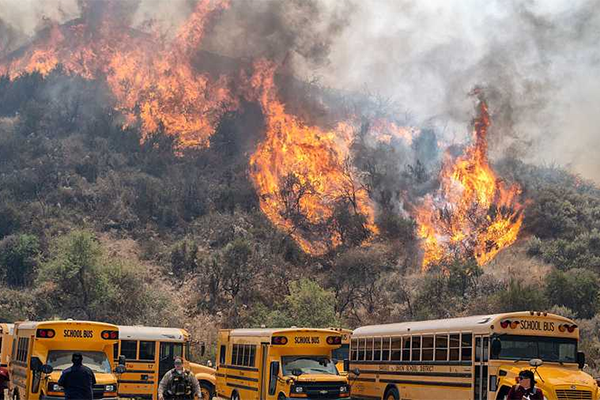
Top Image: Wildfires rage near Centre Pointe Parkway in Santa Clarita, Canada
Photo Courtesy: MediaNews Group/Los Angeles Daily News via Getty Images
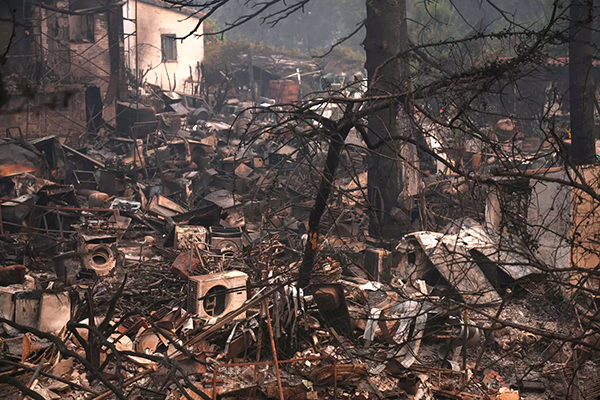
Destruction near Pelayos de la Presa, Spain
Photo Courtesy: Manu Fernandez-AP
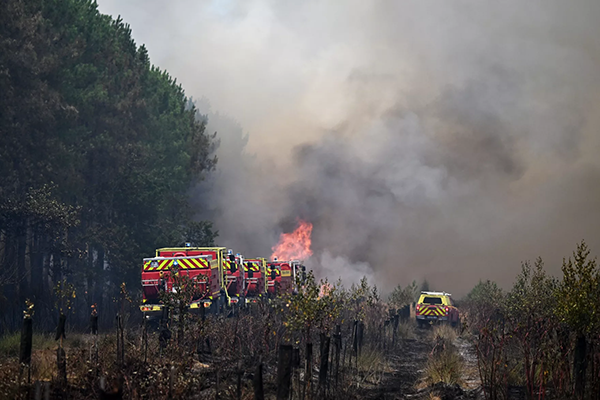
Firefighters tackle fires in the vineyeards of Bordeaux, France
Photo Courtesy: Emma Da Silva-AP
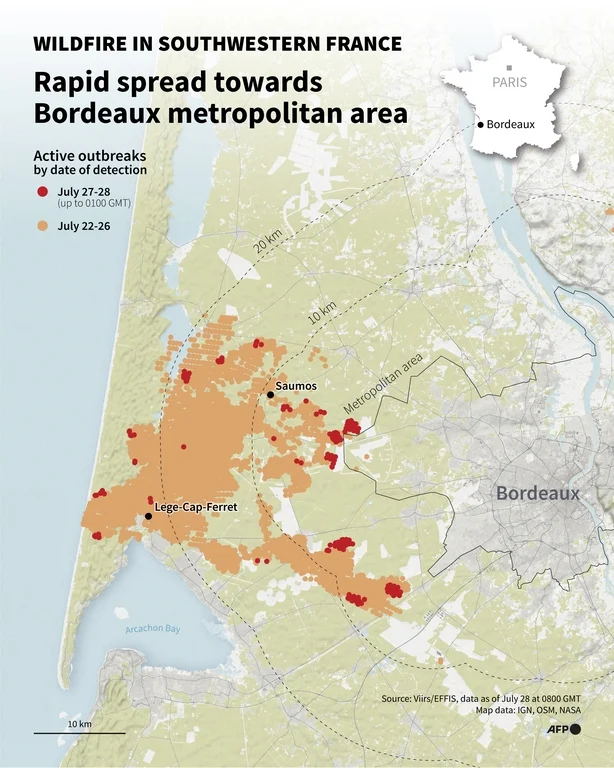
Map showing wildfires currently burning in Bordeaux, France
Photo Courtesy: Viirs-EFFIS
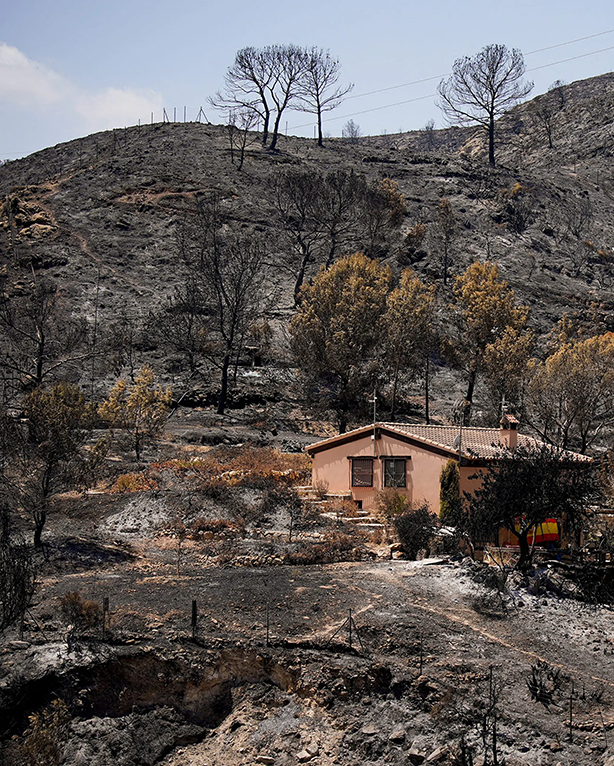
Well-hardened home survives fire near Pelayos de la Presa, Spain
Photo Courtesy: Manu Fernandez-AP